

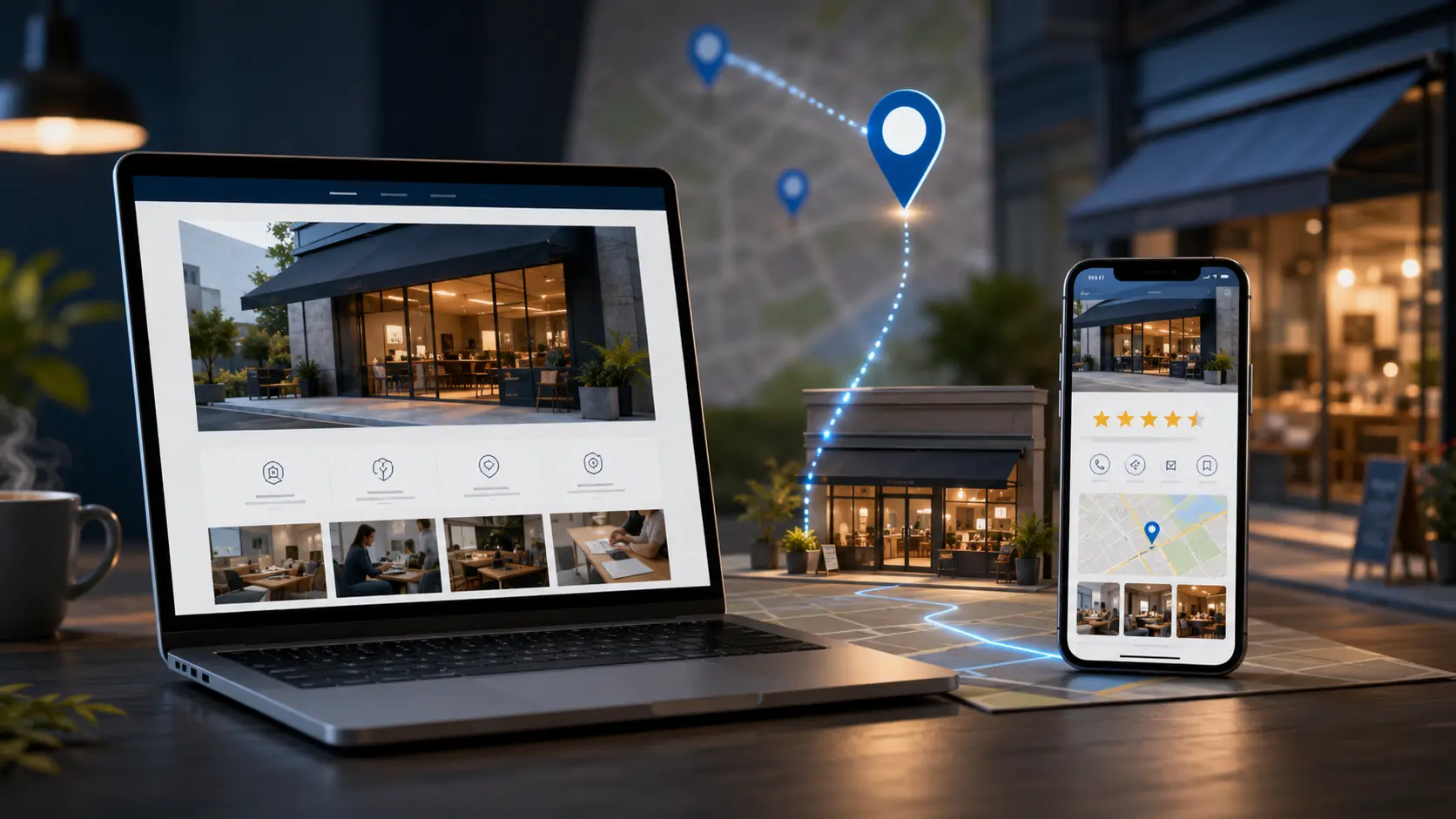
For many local businesses, Google Business Profile is one of the most important enquiry channels.
People discover hotels, cafés, schools, clinics, restaurants, salons, gyms, and service providers directly through Google Search and Google Maps. They check photos, reviews, timings, location, phone number, and website link before deciding what to do next.
But many businesses make one mistake.
They treat Google Business Profile and the website as two separate things.
In reality, both should support each other.
A strong website can improve trust, strengthen local relevance, and give visitors a better reason to contact the business after finding it on Google.
Why Google Business Profile Alone Is Not Enough
A Google Business Profile can help people discover your business, but it cannot explain everything.
It has limited space for deep storytelling, service details, structured content, FAQs, project proof, blog content, landing pages, or full brand positioning.
This is where the website becomes important.
When someone clicks from your Google profile to your website, they are usually interested. They may be comparing options, checking credibility, or looking for more information before calling.
If the website is weak, outdated, slow, or confusing, that interested visitor may not convert.
Your Website Builds Deeper Trust
Google Business Profile creates visibility.
Your website creates deeper confidence.
For example, a hotel’s Google profile may show reviews and photos, but the website can explain room types, parking, safety, family stay, nearby attractions, travel routes, policies, and booking options.
A school’s Google profile may show ratings and location, but the website can explain curriculum, admission process, facilities, teaching methodology, safety, events, and values.
A café’s Google profile may show ambience and menu photos, but the website can present events, party options, menu sections, story, location, and reservation flow.
The website gives users enough confidence to act.
Local SEO Pages Strengthen Relevance
A website can support local visibility through properly planned pages.
Instead of having only one homepage, local businesses should create pages around services, locations, and customer intent.
For example:
A hotel can create pages for family stay, parking, cleanliness, nearby railway station, nearby tourist routes, and destination guides.
A café can create pages for menu, events, birthday parties, group gatherings, live music, outdoor seating, or location-specific searches.
A clinic can create service pages for each treatment and location-focused content.
These pages help search engines understand what the business offers and where it is relevant.
Website Content Can Match Real Search Intent
People search in different ways.
Some searches are direct, like “best hotel in Haldwani.”
Some are need-based, like “safe hotel for family near Kathgodam.”
Some are location-led, like “café near Bhimtal lake.”
Some are problem-led, like “website not getting enquiries.”
A strong website can create content for different search intents.
This content does not just attract traffic. It attracts people with specific needs.
When the website answers those needs clearly, enquiry chances improve.
Consistent Information Builds Confidence
Your business name, address, phone number, service information, timings, and location details should be consistent across your website and Google Business Profile.
Inconsistent information creates confusion.
If your Google profile says one thing and your website says another, users may hesitate. Search engines also rely on consistency to understand local business details.
A strong website should clearly display contact details, location, embedded maps, service areas, and enquiry options.
Google Profile Visitors Need Better Landing Pages
Many businesses send all visitors to the homepage.
But sometimes, a specific landing page works better.
For example, if your Google posts promote family rooms, party bookings, admissions, consultations, or weekend offers, the website should have relevant pages where people can learn more and enquire.
This creates a smoother journey:
Google discovery → relevant website page → trust → enquiry.
Photos, Blogs, and Website Pages Should Work Together
Your Google profile, website, and content strategy should not feel disconnected.
If you publish blogs about local travel, admissions, events, services, or customer problems, those blogs can support Google visibility. If you post updates on Google Business Profile, they can direct users to relevant website pages.
This creates a stronger digital ecosystem.
Final Thoughts
A Google Business Profile can help people discover your business, but your website helps them decide.
For local businesses, the strongest online presence comes when Google profile, website structure, local SEO pages, content, photos, reviews, and enquiry flow work together.
A weak website can waste Google profile traffic.
A strong website can turn that traffic into trust and enquiries.
If your business already gets profile views but not enough calls, the problem may not be visibility alone. It may be the journey after visibility.
That journey starts with your website.
Leave a Reply